
Orquestração de Subagentes: Por Que os Melhores Agentes de IA em 2026 São, na Verdade, Times de Agentes.
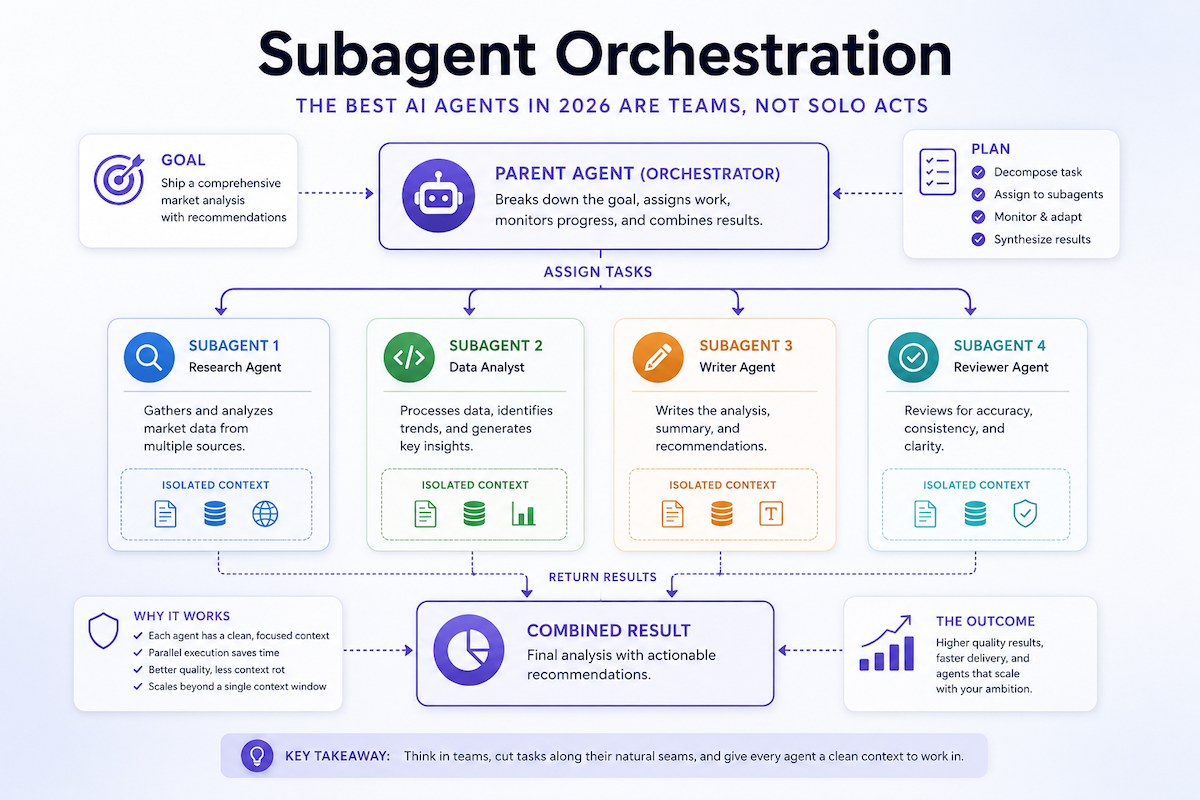
Subagent orchestration is the practice of splitting a large task across multiple specialized AI agents — each with its own clean, isolated context — coordinated by a parent agent that assigns work and combines results. It scales agents beyond what a single context window can handle: instead of one agent drowning in a bloated history, a fleet of focused subagents each does one job well.
The most capable agent setups I’ve built in 2026 don’t look like one super-smart agent. They look like a small, well-run team. This isn’t a stylistic choice — it’s a direct answer to the hardest limit in agent design: context. Once you understand why, you stop trying to make one agent do everything and start designing orchestras.
Why does one agent hit a wall?
A single agent running a long, complex task accumulates everything in one context window — every tool call, every file, every dead end. As that history grows, decisions degrade, the failure mode known as context rot. You can’t out-prompt it and you can’t out-scale it with a bigger window, because models struggle to use information buried in a bloated context. The structural fix is to stop putting everything in one place. That’s what isolation — the fourth move of context engineering — is for: give each sub-task its own clean context so one messy branch never pollutes the whole run.
How subagent orchestration works
The pattern is straightforward. A parent (or orchestrator) agent breaks a goal into sub-tasks and hands each to a subagent that starts with a fresh, minimal context containing only what that job needs. Each subagent runs its own act-observe-decide loop, returns a compact result, and the parent composes those results into the final outcome. The tooling caught up fast: Claude Code now runs dynamic workflows that orchestrate large fleets of subagents, on the 2.1.x line with Opus 4.8 as the default model. The orchestrator holds the plan; the subagents hold the detail — and neither drowns the other.
When should you reach for a fleet?
Not every task needs a team, and premature orchestration adds coordination overhead you’ll regret. Reach for subagents when a task has genuinely separable parts — research several sources in parallel, refactor independent modules, evaluate multiple options — or when a single agent’s context is predictably going to overflow. Keep a single agent when the work is inherently sequential and small. The skill isn’t spinning up as many agents as possible; it’s knowing where the natural seams in a task are, and cutting along them.
Frequently asked questions
What is subagent orchestration?
Subagent orchestration is splitting a large task across multiple specialized AI agents, each with its own isolated context, coordinated by a parent agent that assigns the work and combines the results into a final outcome.
Why use multiple agents instead of one?
A single agent accumulates all history in one context window and its decisions degrade as that window bloats. Multiple agents with isolated contexts each stay focused, avoiding context rot and scaling past the limits of one window.
When should you not use subagents?
Avoid subagents when a task is inherently sequential and small, since orchestration adds coordination overhead. Use a fleet only when a task has separable parts or a single agent’s context would predictably overflow.
The takeaway
The leap in agent capability in 2026 isn’t just smarter models — it’s better orchestration, and subagent fleets are the clearest example. Think in teams, cut tasks along their natural seams, and give every agent a clean context to work in. This is the craft I focus on every day, and I share what I learn here regularly — follow along if you’re building agents, and let’s compare notes.